What If Your Stress Isn't the Price of Success—It's Just Bad Mental Habits?
THE STRESS PATTERN FORMULA
FACTS VS. STORIES FRAMEWORK
THE DICTIONARY MOMENT

Where Stress Ends, Freedom Begins.
Most high performers think stress is the price of success. They accept feeling overwhelmed, losing sleep, and snapping at loved ones as “normal.”
But here’s what I’ve learned after years of coaching executives and professionals: you don’t have to choose between success and sanity.
The framework includes 3 Proactive Practices to prevent stress from building up, and 5 Tools to interrupt it when it shows up.
The result? You perform better under pressure while actually enjoying your life again.
Nicholas Lynch
-IMPACTIMUM
The Stress Freedom Framework is the system I built to help high achievers eliminate stress at its source.
It includes 3 Proactive Practices (to prevent stress from building up) and 5 Tools (to interrupt it when it shows up).
The framework is built around a simple truth: your stress doesn’t come from your circumstances—it comes from your thoughts about your circumstances.
Once you understand this, everything changes. See the full framework →
What You'll Experience
Step 1: Recognize Your Patterns
You’ll catch yourself mid-spiral. Before a meeting, you’ll notice you’re catastrophizing. Before you send that email, you’ll realize you’re mind-reading. Most high achievers don’t see these patterns until someone points them out. Now you’ll see them yourself.
Awareness
Identify what's actually happening
Step 2: Challenge Your Stories
You’ll stop arguing with reality. The Facts vs. Stories framework shows you the difference between what happened and the story you’re telling yourself about what happened. This is where the Dictionary Moment happens—when you realize the problem isn’t the situation, it’s your interpretation.
Reframe
Separate facts from fiction
Step 3: Take Control
You’ll respond instead of react. When stress shows up, you won’t spiral. You’ll pause, check the facts, and choose your response. This is where freedom begins—when you’re no longer controlled by automatic thoughts.
Act
Respond with intention, not reaction
5-Day Stress Pattern Discovery Journal
FREE
A quick-start guide to help you identify the specific thought pattern that’s running your life. Perfect for high achievers who are ready to see what’s really causing their stress.
- 5 days of guided prompts
- Introduction to the Stress Pattern Formula
- Facts vs. Stories framework
- Instant PDF download
- No credit card required
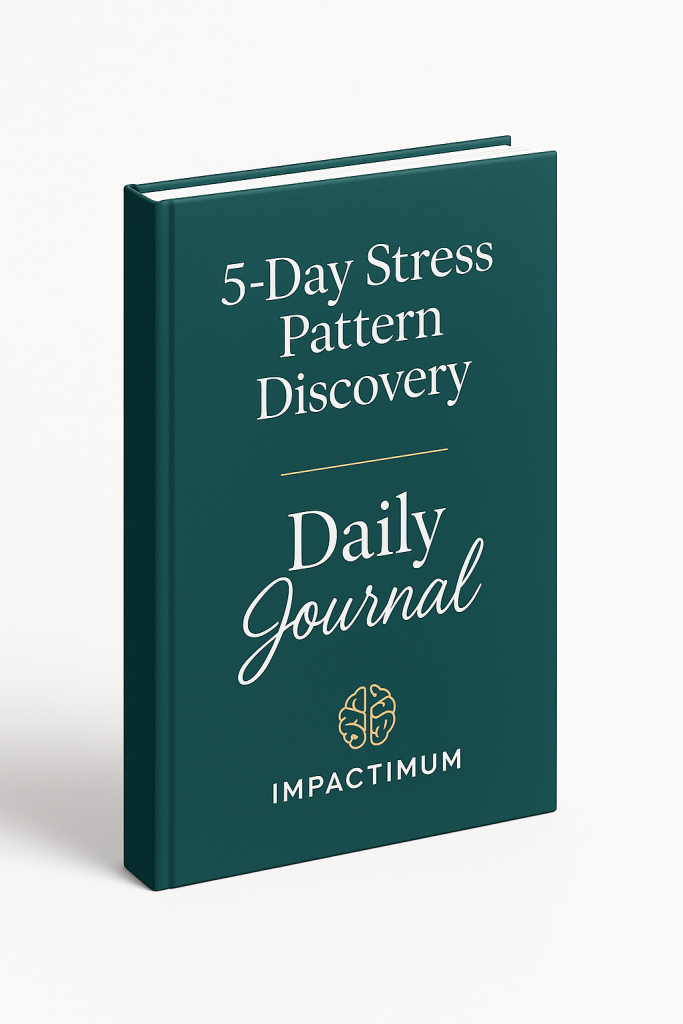
5-Day Stress Pattern Discovery Journal
-
Find Your #1 Stress Trigger
-
See the Pattern You've Been Missing
-
Get Clarity in 5 Days
30-Day Stress Freedom Journal
Transform Your Relationship with Stress-
30 Days of Guided Practice
-
Master the Stress Freedom Framework
-
Make Calm Your New Default
What You'll Lose
What High-Performers Are Saying
Real results from people who stopped coping and started eliminating stress at the source.
I used to think 10 PM emails were just part of the job. I’d get a request from my boss, and my stomach would drop. After going through the framework, I learned to see those emails for what they are: just information. Now, instead of panicking, I pause, assess, and respond with a clear head. I’m still performing at a high level, but I’m not paying for it with my evenings and my sanity.
VP of Operations
My wife told me I was ‘always somewhere else.’ She was right. I was physically at the dinner table, but my mind was replaying a meeting or worrying about tomorrow’s presentation. The ‘Facts vs. Stories’ framework was the biggest thing for me. It taught me how to stop the mental spiral. I’m sleeping through the night for the first time in years, and my family has noticed the difference.
Tech Entrepreneur
I thought I was managing my stress well because I wasn’t having panic attacks. But I was irritable, exhausted, and constantly on edge. The journal helped me see that I was running on autopilot, creating problems that didn’t exist. Now I catch myself before I spiral. It’s not about being calm all the time—it’s about knowing when I’m making things worse than they are.
Senior Product Manager
Ready to Stop Letting
Stress Run Your Life?
Start with the free 5-Day Stress Pattern Discovery Journal and identify what’s really driving your stress.